Money lives on the address. Every completed stop looks up the address's price for the work type that was done, and that is the invoice line. An address with no price produces no line: the work is recorded and stays billable, but nothing is drafted until a price exists. A price of 0 is different: it is a price, deliberately set, and the stop is settled at nothing.
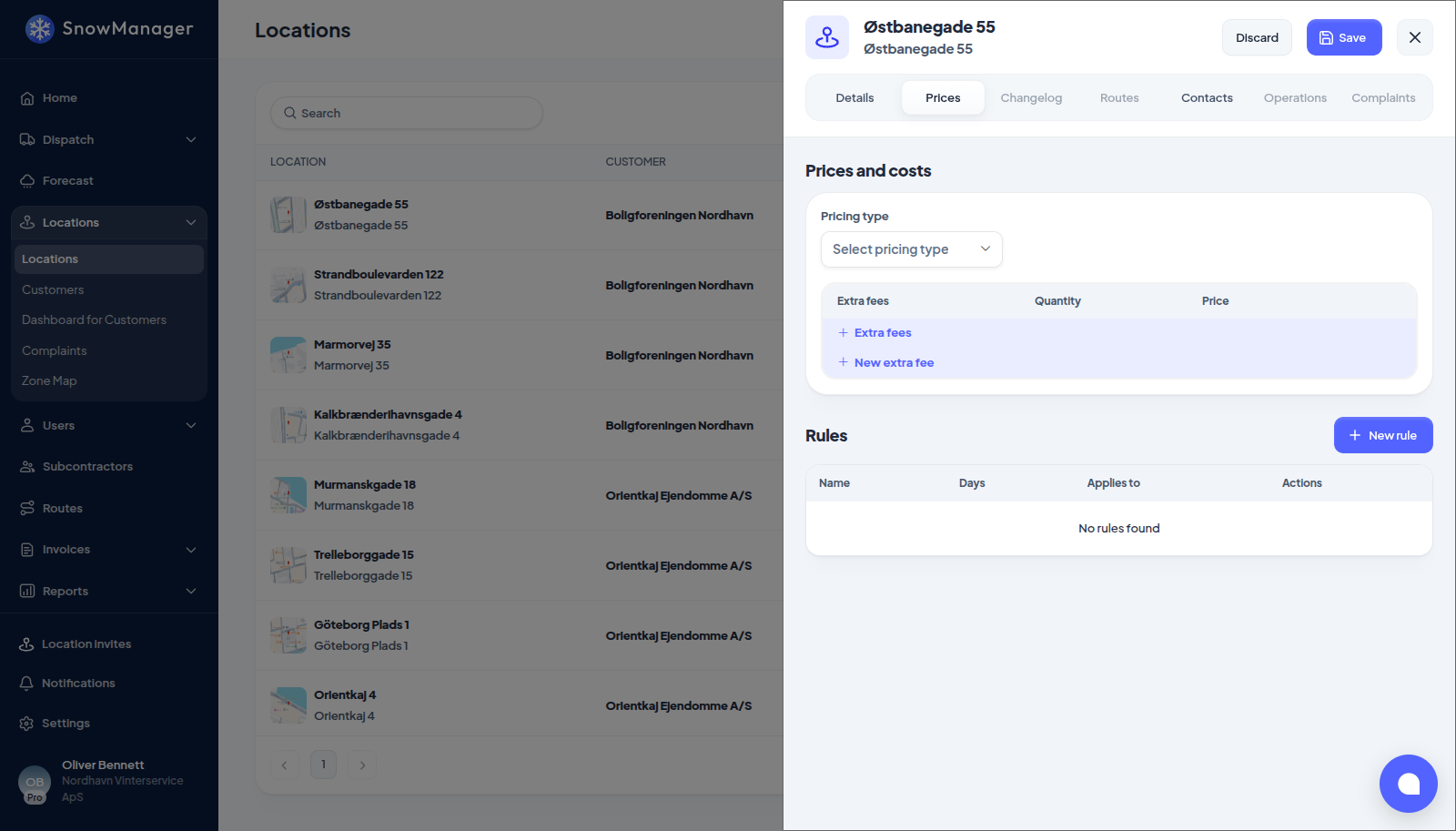
Choose the pricing type
- Open the address from Locations and go to Prices.
- Under Pricing type, pick how this address is paid:
- Per task: one line per completed stop.
- Per season: a fixed amount for the season, billed in instalments, never per stop.
- Hourly: check-out minus check-in, per stop.
- No price: nothing is billed.
- Turn on Set pricing type per work type if the work types differ: salting per task and snow removal per hour on the same address, say. Each work type then has its own type; leave it off and every work type follows the address. To price by how much snow fell instead, switch on Snow depth rules under the price grid: every work type is then priced per task by the same depth bands, one price per band, and the address can hold plowing back below a minimum depth. See Pricing by snow depth.
Enter prices and costs
Under Prices and costs there is a row per work type your business uses.
- Price is the billable price: what your customer pays for this work type here.
- Cost is the internal cost: what you pay the subcontractor for it, if the address is handed out. The cost you enter becomes the subcontractor's price for the address.
- Either may be 0. Enter 0 as a price when the work is free to this customer, or paid for under an agreement settled outside the system; enter 0 as a cost when the work carries no subcontractor payment. The two are independent, so an address can be free to the customer and still pay its subcontractor in full. A negative amount is refused.
- Hourly addresses take a price and cost / h; seasonal ones Price per season and Cost per season, with Payment rates setting how many instalments the season is split into.
Press Save. A row left blank is Without price for that work type, and the list shows Missing prices for the address.
A work type priced at 0 draws no customer invoice line at all, the same as one with no price: a zero-amount line is never put on a customer's invoice. The difference is what happens next. Work done at no price is waiting for one, and is offered for billing the moment you set a real amount (below); work priced at 0 is settled, and is not offered. A season price of 0 likewise produces no instalments. The cost side is untouched by any of this: a subcontractor with a cost on the address is still paid for the same stop.
Extra fees
Extra fees are amounts added on top of the work: a call-out fee, a material charge. They come in two kinds: Material and Fee. An extra fee may be priced at 0 as well, both here and on the catalog entry under Settings. Seasonal addresses may carry extra fees without a cost; they are billed through fee invoices, and the fee table shows how often each reached an invoice this period.
When you add a price to an address that already has work
Setting a real price (a positive amount) on an address with completed, unbilled stops this season opens Bill completed work?: The new price also applies to work completed earlier this season that was never invoiced. Create invoice drafts for these dispatches? Press View and invoice to see the dispatches, row by row, and draft them, or Not now to leave them. The offer comes back whenever you open the address until the work is billed or the season ends. Setting a price of 0 does not open it, because there is nothing to bill.
Where the price comes from on the invoice
A price set here beats the generic work-type price from Settings → Work types, and a rule price (from the address's Rules) beats both when its period matches. Owner and subcontractor each keep their own rows: what you see here is your side; the subcontractor sees theirs, with your cost as their price. Raising every price by a percentage at once is done from the list with Price regulation.